Posts

The Power of Inspiration

Image
In contrast to the frenetic activity that appears to dominate this season, for me, year-end is an important time of reflection and reconnecting. I like to review my journal, look at all the photos we took throughout the year and try to recapture a little of the wonder that recently fell from the treads of life. It's also a time when I am particularly aware of the need for inspiration to thrust forward into the adventure of the year ahead. Inspiration has blazed a trail of extraordinary accomplishment across the pages of history. It is the breath of the divine that fills the sails of human creativity and passion, driving us forward into a hopeful future. Remarkable works of art, innovation, and courage were fueled from this combination of purpose and energy, sometimes even in the most seemingly impossible situations. A few weeks ago, I was recharged by a rare visit from Eric Peterson, founder of Mitra Imaging, a medical imaging company that was acquired by Agfa in 2002 . Since that ...


The People are the Product - Part 3: Innovation

Image
Successfully competing for the future will require continuous disruptive innovation . In organizations where the people are the product , each resource must be encouraged to participate in making innovation a consistent reality. Often, in a traditional organizational model, this type of work is delegated to a small R&D group. In the world of software development and knowledge work, each person is a potential innovation source and an idea catalyst. With this mindset, it's easy to see how collaboration can readily become a powerful innovation accelerator. Here are some practical ideas for increasing innovation across the organization: Opportunity - Google is deliberate about encouraging each employee to spend 20% of their time improving the products or researching new ideas. Many innovations at Google result directly from this general approach. When managing development teams in the past, I have insisted (and measured) that each person spend 2-5% of their time on "breaki...

The People are the Product - Part 2: Alignment

Image
Once we recognize that people are the critical asset of a knowledge-based organization, it is easy to see how human interaction can become a powerful engine for success. In his book " Ten Steps to A Learning Organization ", Peter Kline writes: "The Transformation of Relationships is what, in business settings, we must increasingly deal with. It is now more widely recognized that an organization’s greatest asset is its people, provided they are able to work well together and proceed on a path of continuous improvement. It is also recognized that cooperative team work beats competitive territorialism every time." Organizations are combining these principles with emerging social computing tools to accelerate virtual teamwork and collaborative innovation. The opportunity leaps upward when this capability is extended outside of the organization, creating rich interactions with supply chain partners and particularly with the customers themselves. "It's no longe...

The People are the Product - Part 1: Momentum

Image
Long before the birth of the Internet, Peter Drucker foresaw the growing prominence of "knowledge work" and the changes required by management and leadership to harness this potential. Many of these principles apply directly to the software development industry. When it comes to "Software Engineering", Alastair Cockburn states: " People are Active Devices " People have lots of interesting characteristics, and we don't know what they are - which makes it all the more absurd that we try to define methodologies and processes that incorporate them. Software Development as a Cooperative Game - Alastair Cockburn In knowledge work, the people are the product. It is their potential that creates the possible future, and sustainable value. They are dynamic knowledge repositories and sustainable intellectual property creators. Although the products produced by these individuals and teams represent realizable value, they have a very limited half-life, depreci...

Putting Sanity Back in Business

Image
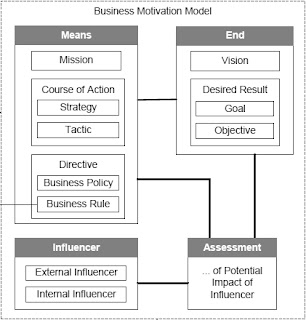
I love models... and I'm not referring to the icons representing our cultural preferences in human vanity. Rather, I'm in love with visuals that portray a rich coalescence of principles and depict in shocking clarity how things interrelate. One such model I revisited lately is the BMM, the Business Motivation Model. A simplified version is shown below: The BMM brings sanity to business by addressing two fundamental questions: What do we need to do? Why do we do what we do? Using a practical and comprehensive framework it allows business planning to adapt strategically in a cohesive and efficient manner. As the BMM Specification states: The Business Motivation Model provides a scheme or structure for developing, communicating, and managing business plans in an organized manner. Specifically, the Business Motivation Model does all of the following: It identifies factors that motivate the establishing of business plans. It identifies and defines the elements of business plans. I...

IP Bunker Buster

Image
Protecting intellectual property has become a harmful preoccupation for many leading-edge software and knowledge-based companies. Security policies, fear of competitors, and growth through mergers and acquisitions have created isolated knowledge silos across the organizational landscape. Unfortunately, the very dynamics used to protect this most valuable asset ironically creates significant barriers for innovation. The end result is a growing stranglehold on the ability to generate sustainable future value. It shouldn't surprise us that the antidote to this problem is currently playing out on the world wide web in a high stakes challenge of social networking innovations. What does connecting people have to do with innovation? People are sustainable dynamic IP generators People provide expertise and informal access to needed knowledge, easily doing end-runs around poorly managed IP protection strategies. "Who you know" has always been a significant component in effecti...

Getting Personal with Personas

Image
How do you get a large development team to make effective design and implementation choices? Often, it takes a short "walk in the shoes" of their most important audience, the user of the products or services they produce. "Our R&D staff need to spend more time in the field!", is the oft-quoted postmortem remedy. And of course while everyone is traipsing about the planet, blowing travel budgets, the clock keeps ticking as nervous sales organization wonder who will create the next value-add improvement that they can sell. Fortunately, there is a solution to the deadlock. The emerging practice of persona development has proven to be a great tool for accurately conveying a consistent set of user goals and behaviour to the implementation masses. Personas don't need to be fed, don't sleep, and will live inside of your development organization to continually help re-connect everyone with what's valuable to their users. Not using personas in your context...

Requirements - a False Sense of Security

Image
The Challenge In an industry with over 35 years of software engineering experience, it's amazing that we have failed to produce any significant breakthrough that improves the ability of executing successful software projects . The brightest minds have been humbled battling the tide of anarchy that persistently undermines the progress of their complex initiatives. "Discipline and control", the gurus cry, will help curb our irresponsible creative surges. Envying their manufacturing counterparts, knowledge workers have reached out to embrace disciplines that have reduced the insanity while simultaneously eroding innovation and creativity beneath the weight of bureaucratic process and fragmented work distribution. In this protected environment, the "sigh of relief" eventually evaporates into a new level of panic, as emerging competitors run roughshod across existing markets with disruptive innovations. Successful assembly and delivery of complex artifacts is ulti...

Communication Bridge: Picture my Business

Image
Each year, millions of dollars dissipate via projects that provide little residual value to their sponsors and end users. The source of the problem: an ever-widening communication gap between complex business needs and convoluted technical capabilities. Yet there is hope. One of my favourite bridging devices is a powerful visual modeling standard called Business Process Modeling Notation (BPMN) . Currently undergoing acceptance by the OMG , BPMN aptly crosses the chasm, clarifying business value and contextualizing technical capability through the following characteristics: Uses a common modeling language, easily understood by business and technical stakeholders Facilitates efficient process knowledge sharing for Business to Business (B2B) applications Addresses problems with previous attempts in using "software oriented" UML notation for business modeling Provides round trip engineering with XML based business processing languages like BPEL4WS Download an HTML version o...

Crossing the Starting Line

Image
What does it really take to successfully launch a new business? In this extraordinary interview with Amar Bhidé , author of the book The Origin and Evolution of New Business , the editor-in-chief of Inc. Magazine draws out some incredible truths from the research done by Dr. Bhidé. Here are some highlights from the article summarizing 10 years of study that fly in the face of conventional wisdom: Most successful startups began without any innovative idea or product, with no specialized training and with relatively little capital. Critical success characteristics for entrepreneurs are: tactical creativity; adaptability and salesmanship. Successful entrepreneurs are very tolerant of ambiguity and find opportunities in uncertain "me-too" market niches, where they can offset risk to customers and other partners. The characteristics that propel a new business to initial success must shift to strategic planning and risk taking if the entrepeneur wishes to take the business from ...

Open Sesame

Image
An Open Door The Internet has created radical new facilities for individuals to collaborate independent of geographical and economic constraints. Riding on the wave of this capability, is the growing phenomenon of open source development and services. This altruistic, voluntary trend is impacting the economics of software production around the globe. Although some would trivialize these attempts as insignificant, many others are jumping through the open door of opportunity. How do organizations make money from open source software? This ZDNet article summarizes how: Selling related services such as packaging and documentation Selling support services Creating custom licenses for particular customers Producing proprietary software that integrates with an open source system Of course, the product mixing strategy requires specific due diligence for an organization to ensure that they do not compromise the open-source licensing with their proprietary distribution. Here is some helpful ...

A Beautiful digital Mind

Image
I've long been fascinated by the effective use of Wikis to incubate and nurture research and information organically. Exposed to the power of Google search and the breadth of information on the Internet, everyone struggles with how to best interface their brain with the informational waterfall. Common approaches include: Bookmark mayhem - bookmark everything and then try to organize your bookmarks Tagging - a more flexible, generic style of bookmarking Gross capture - using cut and paste methods to copy verbatim information for future reference, hoping you can find it later. Wikis - value add contextualization to referential information in a searchable knowledge incubator. I was recently reminded of how crucially interdependent I have become on my personal Wiki in light of the number of projects that I'm juggling. I had switched to Microsoft OneNote for a couple of months, attracted to the ease of drag-and-drop capture from the Internet. Additionaly, OneNote automatically...

Incubating Online

Image
One of the key challenges of facilitating business startup ideas is having an effective, low-cost virtual collaboration capability. Emerging out of the Web 2.0, AJAX enabled Internet services is an exciting number of innovative offerings. I've been using several of these sites in managing virtual communications and projects. Not only are these tools effective, but they are also free! Here are three sites I've been using: www.Airset.com Airset is a collaboration environment centered around calendaring. They provide a convenient tool to synchronize with my Palm, allowing full control over which appointments are shared based on categories. You can readily create multiple groups and easily manage merged views. The system includes the ability to selectively share contacts, to do lists and traditional discussion forum tools. The service is free with no published limitations. The system does not include any collaborative editing or filesharing capabilities. I use this system primaril...

Getting Things Done with Gmail

Image
I've been long fascinated with David Allen and his " Getting Things Done " methodology. David has spent the last 20 years coaching executives on how to get their lives organized and more productive. Life in the information age requires the dual skill set of coping with an overwhelming amount of incoming data and managing a large volume of critical activity. A quote from the book sums up the challenge: A paradox has emerged in this new millennium: people have enhanced quality of life, but at the same time they are adding to their stress levels by taking on more than they have resources to handle. David's methodology, abbreviated as GTD, involves the following disciplines: collect everything explicitly, outside of your head process your inbox quickly, regularly and thoroughly decide outcomes and the next actions every time you review new information do quick actions immediately delegate, schedule or defer tasks to appropriate contexts break complex tasks into projects d...

An Alternative to Anarchy

Image
Chaotic Behaviour When faced with complexity, many organizations and individuals resort to primal behavior. The queasiness of being out of control often generates these symptoms: Baby Throwing (along with the bath water). Wholesale abandonment of what was not working along with what was starting to work. The greater the sense of panic, the more frenetic the thrashing between various strategic initiatives. Each of these cycles is often accompanied with a fresh crop of executive managers. Paralysis. Lack of confidence in decision-making. A despair-ridden death march as profit margins slowly vaporize and innovative opportunities flit by ungrasped. Fascism. Charismatic leaders riding the waves of popular paranoia for personal benefit for questionable agendas. The shifting sands of complexity provide poor footholds for accountability and objective measurement. Cynicism . Change fatigue and the inability to connect with meaningful purpose often rapidly diffuses a creative workfo...

Visualizing Complexity

Image
Humans have a number of ways of coping with complexity: We pretend it doesn't exist, and are surprised when our simple "cause and effect" worldview doesn't work. We dissect and fragment it. The bits soon take on a life of their own, often creating comforting rituals bereft of context and initial purpose. Occassionally, someone helps us re-synthesize and "get the big picture" once again. In striving to increase my ability as a "complexity visualization" agent, I have experimented with a variety of mediums, and watched how others have successfully transformed information. A company that has aptly demonstrated this achievement is Xplane . On their web site, they show how fragmented, prolific content can be transformed into powerful, information-intense visuals. Eduarde Tufte, the data visualization guru, also has produced some innovative work in visualizing complexity. On his web site , he demonstrates how sparklines (intense, word-sized, si...

What's in a Name?

Image
Choosing creative, meaningful and available business names is not a task for the faint of heart. In my recent endeavours, I found the following tools to be very helpful: Marcia Yudkin has assembled a useful process that, although does not do the work for you, is rife with links to useful tools. Your best friends in this process are a thesaurus, homonym and cliche references, rhyming dictionaries, and various name databases. To check for domain availability, try out these web sites: http://www.internic.net/index.html http://www.makewords.com/default.aspx?src=business Good luck!

Purpose - The Heart of Design

Image
I have had the great privilege of participating in the rediscovery of key design principles through the recent renaissance led by the likes of Alan Cooper ( The Inmates Are Running the Asylum) and the folks at IDEO . Using a fresh emphasis on observation and the capture of customer behavior and goals, they have successfully realigned our methodologies of how to sustain success in this overengineered culture. The questions, "Why are we building this?" and, "How can we make this more compelling?" have gone far towards improving our existing offerings. More importantly, they have helped us connect with the core purpose of our products and services, a critical conduit to the value opportunities in an increasingly complex world. In addition to rejuvenating our production value, the same principles can also be applied to the organization as a whole. When business leaders help their teams effectively connect with their shared core purpose, it creates a significant synergy...

Nyquist, Knowledge Transfer and Screencasting

Image
I began successfully using voice and screen capture over 10 years ago. At the time, we were doing experiments in alternative learning methods. Since that time, I've successfully used Camtasia for many projects. My most effective use of screen video capture was rapidly creating online training material. In the high-tech boom, recruiting and getting new team team members productive became priority one. Since we couldn't hire people fast enough, we added up to four co-op students per semester as well. How do you successfully bloat a knowledge-dependent team without being crushed by your own weight? It boils down to leveraging the Nyquist theorem and applying it to the disciplines of knowledge transfer. The theorem states: When sampling a band-limited signal the sampling frequency must be greater than twice the input signal bandwidth in order to be able to reconstruct the original perfectly from the sampled version. My application of this principle: To effectively transfer k...

Generative Relationships

Image
There's been much hullabaloo about social networking, virtual collaboration and the magic that is generated by creative, informal teams. Many organizations and individuals see networking as a means to an end. How do I find a job or advance my career? How do we manage this complex project? How do we continue to innovate for sustained success? Although these are all worthy goals that have experienced some remarkable dynamics from social networking, what about the network itself? What about the relationships themselves? I believe an effective relational network has value on its own merit. As humans, we derive great joy developing mutual friendships that are both meaningful and interesting. Try viewing the relational network as an end in itself, and the things done together as means to reinforce and solidify healthy, enjoyable relationships with interesting people. In their article on Generative Relationships , the authors highlight the dynamics that turn relationships into magic. It...